

Myths and Legends
Like all good stories, there was a beginning...
The world that is laid out here is one of immense wonder, miracles, mystery, tragedy, and hope. The heroes that set out upon it in search of their destiny and higher calling trod upon ages of unknowable history, but will write a new one all their own, and shape the world forever in their wake.
Mythology is what is purported to have come before, as passed down through stories and songs. While there may be scrolls, sagas, and tomes written of the time before, those in power control what is considered “history” and what is considered Myth.
For millenia, that power resided in the Empire of Sargos. And while it is now destroyed, its people scattered to its disjointed provinces; its legacy is powerful, and still shapes the framework of the world.
No one has a firm grip on truth. But truth can still be gleaned, and there is nobility in its pursuit.
The Ages
The modern age is one of revival and expansion. There is a tenuous peace across much of the known lands, which has fostered trade, learning, and investment in the arts and sciences. Some lands are at the forefront of these exciting times, and some are still rebuilding from past wars. But there is a dawning hope in the world.
There are places to discover. Seas yet unmapped. The ruins of lost civilizations have been purported to be found in the far reaches, and with it, long secreted sciences and magics.
But as civilizations race to capitalize on this age of opportunity, there are those who see peril on the dawn. Old magics were lost for a reason. The seas, were long uncharted, for good cause. Some see shadows growing from the ambitions of men, and new marvels bring merely innovative ways to bring death and suffering to a still young world.
What follows is the collected writings of Donaeus Agrisum Callix, High Magister of the Libraries of Arcaenum, and personal Historian to Sargon Gaian Imperix Athis, compiled in the year 1174. The title of the work is Historia Regem Populusque Sargosi. Three copies were said to reside in Arcaenum before the Day of Rending, one copy in Ullum, three in Eigus, and two in Auromos (now Portasang).
While Donaeus was a well respected author and scholar, he was known to have a flair for emphasizing the role of Sargos in the world, and relegating the conquered to debased depictions of drooling barbarians, or godless heathens. His works form the foundation of the educated world’s understanding of the Age of the Fae, and of Legends.
Age of the Fae
What is known of this age, the first age, is the fodder for scholars and theologians. Although bards recount tales of steadfast adventurers stumbling upon ancient relics, temples, and even lost cities of the age; most assume this fanciful storytelling over a true accounting. But stitching together these conflicting tales, a glint of truth emerges, or at the very least, a legendary throughline.
The world once was cold. What is now sea was once land. It was an age of severity, cruelty, and bereft of all hope.
Some religions say the Fae crafted mortals, so great was their power at the dawning of the world. Other writings and stories speak of them as invaders who subjugated the world. What is shared in common with these scattered tales is that long ago, its age and length lost and forgotten, the Fae ruled supreme on the world, and humans served them.
Magics shaped mountains, carved out seas, and bent the world to their whim. They ruled as gods, and warred amongst each other, with humans as their armies.
The Legend of Gavenas the Bold speaks of the creation of the Nemedians by the Fae, merging man with beast, to create a fearsome army of powerful soldiers. The Kalistani Scrolls of Chensi tell of how they imbued humans with the soul of the North Wind, creating the Eldan people of Vistalvin.
At some point, things began to change. The Fae split into factions, some bent on the destruction of all mortals, others in protecting them. Some still felt that the world was the domain of man, and man alone, and it was time to leave the world entirely.
Humans were taught magic, and with it emerged as equals to the Fae who subjugated them. Some religions preach that it was the gods who aided mortals, and gave them the power to shuffle off the chains of their overlords. Though there are accounts of a powerful faction of Fae who brought power and wisdom to humans.
Regardless of how humans became so enabled, they won their war. The cost was dire. The seas became land, the land became sea, mountains broke, and a new world was born. Pacts were made, and the Fae retreated in to the twilight lands between worlds. Their dominance of the world, and of man, ended.
Excerpt from the Legend of Gavenas the Bold
As Translated from Old Ulnas
Born he unto the sealed path and home unto the strong of arm, Gavenas grew under the covetous eye of Avaena, Witch, and queen of the rime. Come hither me child, and all to ask will come unto you, and as payment and grant, to me shall gift but one in return. Gavenas asked for strength of bear and speed of elk, for warrior skill, dauntless, fierce, and unto him no equal in arms.
Avaena, cold as night, white as sea foam, would grant all and more but for Gavenas gift of his noble heart. Gavenas gave shout to all to hear that no creature of cold no witch of night could own a heart so fierce, so hot.
With righteous spurn he denied the rime queen, and with malice and spite she cursed him with the gifts of which he had asked. With horn of ram, and hoofs of iron, with arm of bear, and teeth of wolf. Savage heart and savage mind, a beast of night, to shout, to cry, Gavenas the Bold was broken low, and his howls now echo in the cold night.
The Arbiter’s Oath
From the Litany of the Three Sovereigns
Magic is the safeguard of the world, and unto man the tool of creation, and destruction. As Arawn saw in his wisdom to teach mankind the shaping words, the focusing rod, and the song of creation, I shall prove worthy of such implements, and as those before me, defy the bondage of spirits and the corrupted. I shall be as temperate as Spring, as directed as the sun, and as firm as mountain roots in my duty and charge.
Bander and the Dragon
Almatian Legend
Unto Seolfer, god of sky and of storm, did the priests prepare a sacrifice of cattle. But Aslinax, a dragon red as flame, did swoop upon them, and carry them to his lair. Bander, with sling, with spear, and with bow, hunted Aslinax over river, over mountain, and into dark caves. In the darkness of the deep, Bander came upon Aslinax asleep; his claws as swords, his teeth as spears.
Bander filled a cow with pitch, with tar, and with hay. He surrendered to Aslinax and offered him the cow as feast, as homage and tribute to his greatness. Aslinax ate the offered cow, then gathered flame in its mouth to punish the lowly Bander for his trespass. But the fire from its belly did ignite the cow’s innards, and in a flash of fire, and a boom of thunder, Aslinax was slain.
Bander returned with the sacred cattle, and a great offering unto Seolfer was sent into the sky. The people rejoiced, and Seolfer did bless them with long days and fortune.
Those of Earth, Wind, Water, Fire, Iron, Wood
The Scrolls of Chensi
Balixa the Jann of Earth, crafted them. To mine the deep of gem and gold, the fae shaped man into the dwellers of the dark. Strong of arm, with cunning and guile, they delved the mountains for their master’s plunder.
Soreena, the Jann of Air, crafted them. To sing, to light, to raise the hearts, the fae shaped men into winged children. Voices like silver, to dance and to twirl, they gave light and gave joy for their master’s grim souls.
Rettam, the Jann of Fire, crafted them. To fight the wars, and subjugate enemies, they were made with arms to strike the body, and horns to strike the heart. They served their master’s conquest of their enemies.
Undra, the Jann of Water, crafted them. To sail the seas, guide the vessels, shepherd the fish, and bring the waves of wrath. With skin of silk, fins, and strength of coiled body. They served their master’s rulership of the sea.
First Men: The Titans
Educated Conjecture on Collected Tales
The following is a topic of great interest of historians and scholars throughout the Empire, and was first made popular by Kiris of Adelor; noted magister of Thendare.
It is clear and true that mankind is the inheritor of the world, and the fae that torment the wildlands are usurpers, interlopers, and an enemy. Their pernicious incursions across the empire are dying gasps, that while dangerous, no more meaningful than a child denied their playthings. For at one time, this world was indeed their plaything; although, it was never their inheritance. The first men, who we shall call the Titans, were not unlike the gods.
Ruins of ancient cities belonging to them have been found in Edor, Thendare, and even Caltova. What few ruins have been found have awarded adventurers with plunders of wealth to make any regional governor jealous, and riches of intellectual pursuit to stir debate among scholars for generations.
What can be surmised is they were giants. That is to say, of gigantic proportions. By their skill and knowledge, apart from their size, they bear little resemblance to the giants of today. But that is not to say the two, and we as well, are not unrelated.
These Titans warred with the Fae, of that we are clear. Whether the way to the twilight realms was opened from this material and base world, or from the other side, is unclear. Nor is it clear who weakened the bonds of the veil such that passage was made so easy, or to what ends. But it is more than likely that the Fae, initially, posed little threat to the Titans.
In point of fact, many scholars, myself among them, believe that the two were at first as equals, and exchanged knowledge, and even developed alongside each other. But the Fae betrayed the Titans, cursing their bodies, and their minds. The weakened shells of the mighty Titans are the ruined rigor that holds up mankind today.
It is also likely that the giants that still walk the world are the Titans of old, cursed with a feebled mind, but retaining their girth and physical might. This made them easy to control by the Fae, and why so many serve them to this day in the Uffern.
The Age of Legend
While the sources that refer to the Age of the Fae are slim, and contradictory in many ways, the stories that bear out the Age of Legend are many, and widely varied. Largely, they speak to the developing people of the various regions of Edor and Adoran, their worship of their gods, and their struggles for land, resources, and against the terrors of the world.
Legends of Edor
Edor, or “The Treasure,” in Sargosian, is the bulk of western Oris. From it come the tribes of Loth, and Myd, the sorceress Alendra, and many of the gods of Parvadei.
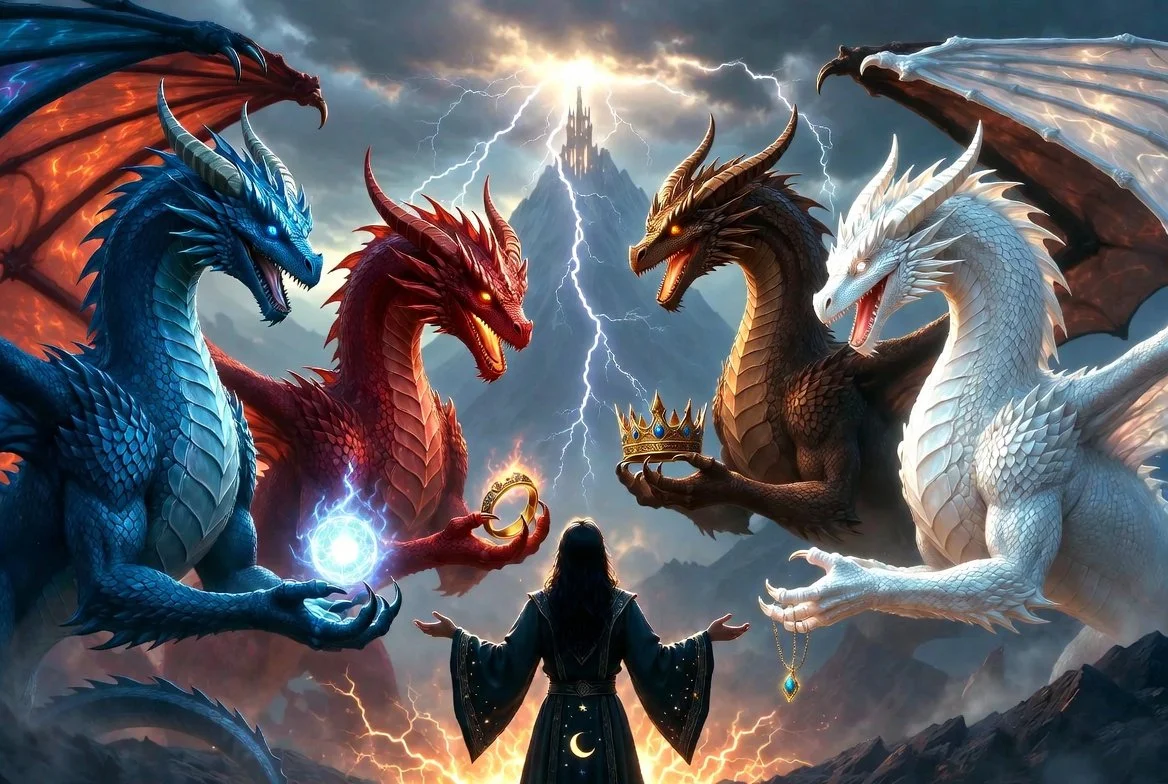
Alendra and the Four Dragons
The magic known as the Inner Pillar owes its foundations to the people of Venefica, and the ancient order the Sisters of Voyantis. First of their order, Alendra, daughter of Ardis, awoke to her magical prowess when Vashandes the Sky Breaker, great wyrm of the north, laid waste to her home. Her mother, her father the chieftain, her sisters, and her brother, burned before her.
She sought out the goddess Ealyndryl to learn to master her art, who in turn evoked within the young witch the inspiration she needed to hone and perfect her craft. Alendra then taught this craft to other sorceresses in the tower of Voyantis, in the heart of Venefica.
In her hunt to free the realm from the terror of Vashandes, oldest of his kind, she first sought out the dragon Tritania the Flame Eater.
With her magic she brought Tritania to heel, and demanded three things in exchange for her life. She demanded the secrets of fire, a bauble for tribute, and the greatest fear of Vashandes. All of which Tritania delivered.
She then did this with Gallis the Earth Mover, and of him demanded the secrets of the mountains, a ring for tribute, and the greatest weakness of Vashandes. All of which Gallis delivered. And then on to Crimax the Ice Breather, of whom she demanded the secrets of water, a crown for tribute, and the knowledge of the greatest strength possessed by Vashandes. All of which Crimax delivered.
At last she, and her witches, came upon the ancient Vashandes. When Vashandes went to summon a storm of wrath, Alendra had banished the clouds, and rendered his greatest strength impotent. When he howled with rage and stomped and stretched his mighty wings, Alendra caused the earth to rise, and denied him the sky. Terrified, and without his greatest weapon, Vashandes parlayed for his life.
Alendra demanded the secret of air and sky, a throne for tribute, and his obedience for the rest of his days. All of which Vashandes the Sky Breaker supplied.
The Hounds of Cluth
Cluth, a chieftain in the lands of Loth and Myd, was a famed hunter. His armor was made from the skins of basilisks, his spear bore the talon of a drake, and his cloak was made of the fur of a sword-tooth lion.
While hunting in the old forests he came upon a massive tree, with each root as round as an old tree, its boughs scraping the clouds. There resided Fiondana, a Dryad, Lady of the Evergreen. So deep and fast was Cluth’s love for Fiondana that he swore to serve her until his last day.
Stricken with the mortal, Fiondana issued him a challenge, and bade him return to her with three gifts: a silver apple from the Tree of Lament, an acorn from the Tree of the World’s Birth, and a leaf from the Tree of Promise.
Cluth spent twenty years seeking these gifts, and his fame and name spread far and wide. He returned to the ancient forest, tribute in hand, enflamed with longing for his love. But the forest had been cut in his absence. Fiondana had died of despair, her treehome corrupted with rot, the streams that had fed her blackened with industry.
He begged Saedra, goddess of the Hunt, to grant him the strength to deliver vengeance. He offered in sacrifice the gifts he had gathered for his love to Saedra, who then became enraged. For Saedra had loved Cluth from afar, and when he offered her trinkets he procured for another, her rage became without equal.
She said unto Cluth: Mighty Hunter you are, but mightier still you shall be. I shall grant you eternal thirst for the blood of your enemies, but you shall stay at heel by my side, from now until the final setting of the sun. And so Cluth became a werewolf, dog unto Saedra, master of her pack.
Legends of Mercedor
Mercedor, or “North of the Treasure” in Sargosian, straddles the north of Edor, and is the home of the Bearmen, and the Beastmen.
Dirge of the White Wolf Clan
Thane Wulfric Dead-Eye had gained his fame and power by defeating the giant known as Grix, and felled him with a single blow from his axe. He returned home to find that his son, Ludmir, had been killed while wrestling with Alfrin the White Wold.
Alfrin claimed the boy had fallen on to a stone, and that it was not by his hand that poor Ludmir met his end. He claimed his death to be the will of Mharaz. Thane Wulfric, consumed with rage, demanded he and Alfrin fight to determine the will of Mharaz. If Alfrin spoke true, then Mharaz would deal him the victory.
They dueled from the rising of the sun until its setting, and as the sun reached the horizon, Wulfric dealt the killing blow, striking deep into Alfrin’s chest. As Alfrin was struck, the self same wound erupted on the chest of Alfrin’s two elder sons, and on his seven young grand children. Alfrin’s new, and young, wife is said to have howled in pain that same moment, as her unborn child emerged still born, with a deep gash upon his chest.
With one blow, Mharaz, god of Vengeance, had ended the White Wolf clan.
The Bravery of Gund
Viggur the giant visited upon the Haderon tribe of beastmen in the cold reaches of Borea. He felled their huts, devoured their goats, and had one by one eating the beastmen. But in his rapacious hunger, the helm of a beastman had become lodged in his tooth. Viggur fumbled with his teeth, but his thick fingers could not grasp hold. He tried spears, and tree branches, but could not reach the helm.
His pain was great and he began to wail. Gund, a young beastman, emerged from hiding, and offered to help. Viggur, desperate for aid, carred Gund to his mouth. Gund grasped the helm, and pulled it free. Viggur shouted in joy, then swallowed Gund whole.
But Gund knew Viggur would do this. He carried in sacks at his waist the dung of cow, and bundles of neep. Viggur became sickened, and all at once vomited out all the villagers he had swallowed. They all gathered weapons, and slew the sickened giant.
To this day the beastman will say “Nonmemor Rudga,” which means: “don’t forget the turnips,” when someone is rushing in to danger. Or the more popular axiom: “Viggur has had enough of bullshit.”
Legends of Adoran
Adoran, “Land of Mountains,” east of the Huzor Sea, is dark, and mysterious. Although its main settlements pay homage to the Sargon, so much of the land is guarded by inhospitable terrain that whole peoples live in valleys and deep forests, that have yet to know the name of Sargos.
Vaga the Fate Spinner
Ravik the Fair was king of Tarkanis, and all his glory was due to the blessing of the goddess Bendis, who loved him dearly. Bendis blessed Ravik with skill in spear, with keen eyes, and she guided his arrows in battle. Bendis promised Ravik he would never fall in battle in so long as he stayed true to her in his heart.
But Vaga too coveted Ravik, his great house, his strength, and his power. She was a sorceress who could pull the threads of fate. She seduced Ravik and swore to him that her magics were as powerful as the gods, and she would deliver him more glory than any god. Ravik wed Vaga, and Bendis wept.
Vaga, wife of Ravik, Maiden of the Veil, bore him many children, and her dark magics kept the goblins of the Uffern, and the Sidhe of Mystabor at bay. Together, she and Ravik united countless tribes, and the people that came from this union were grim, and resilient.
But while Ravik was loved, Vaga was feared. Her magic could change destiny, and while to those she favored their fortunes were great, to those who wronged her, there was no greater curse.
Ravik had left his great hall to hunt Zandalphon the Shadow Stalker, great dragon of the east. While he was away, an old crone came to visit, claiming kinship with Ravik, and asked for shelter from the cold. When Vaga beheld the ancient woman she recoiled in disgust. So revulsed was she at the woman’s brazen requests that she began to spin her fate. But the magic failed, and the woman revealed herself to be Bendis, goddess of the moon.
For Vaga’s weaving ways she was changed into a hideous spider with the torso and head of a woman. She was hunted by her own people. and driven from Ravik’s kingdom. But Ravik’s fate had long been girded by his sorceress wife. Without Vaga’s magic to protect him, Ravik’s arrows missed, his spear arm faltered, his eyes could not pierce the darkness, and he fell in battle.
The Armies of Bronze and Stone
The dwarves of the Smouldering Mountain lived in peace with the tribes of Avaria, Hyrhonn, and Molendi. The dwarves provided the men copper, tin, and silver, and the tribes would bring them wheat, fish, and things not found in the belly of the mountain.
King Hadrik of Avaria, King Gustaver of Molendi, and King Nithus of Hyrhonn, knew the dwarves held in their vaults glimmering gold, and fair gems. Hadrik and Gustaver felt such treasures should be theirs, for their numbers were great, and the dwarves did not march to war.
We keep these lands safe from the giants, they would cry. We protect their homes from the dragons, they would shout. What value are gold and gems to they but to sate their greed, they lamented. But Nithus rebuked their wails, shamed them for their covetous ways, and withdrew from their company.
And so Avaria and Molendi marched on the Smouldering Mountain and demanded the dwarves yield up their gold, their mountains of gems, and all they had stolen.
From the iron gates Kazan, home of the dwarves, emerged fifty men of stone, and twenty men of bronze. They wielded swords made of iron, sharp, and unbreaking. Five thousand men had gathered against Kazan, but were no match against the men of stone and bronze. The men of Avaria and Molendi were slain, every last one.
The men of stone and bronze then continued their march into the lands of Avaria and Molendi, but Nithus of the Hyrhonn pleaded with the dwarves for mercy. But the dwarves could not stop the men of stone and bronze. They knew to destroy Avaria and Molendi, and would not stop until the deed was done.
So the dwarves gave King Nithus seventy gems, and gave him the knowledge to stop the men of stone and bronze. So narrow was their goal that they could not defend themselves from Nithus and his men, for they were neither of Avaria nor Molendi. And the homes, children, and wives of Avarian, and Molendi people were saved.
Nithus and Hyrhonn were named brothers to the dwarves, and Kazan would share with them its gold, its gems, and its treasures uncounted.
Legends of Sargos
Before the founding of the Sargosian Empire, the peoples of the region were of Estix, Garion, Sindor, and Almatia.
The Raven Queen
The Almatian elves, or “the mound builders,” owed their prosperity to the fertile valleys of Oslacus, and their protection to their queen, Madb Dunathine, priestess of the Raven Queen; Corvina. Legends are confused on this, as some hold that Madb and Corvina were one and the same, and that Madb was a goddess made flesh. One account attempts to tie the duality of Madb and Corvina to an apotheosis, not unlike the legends of Amon. Others still say they were sisters, and Madb was a goddess as well.
Regardless of these variations, what all of them share is the perspective that Madb was powerful, and capable of working miracles.
Madb desired to own access to the sea, and so she came to the Beul Namara, and with sorcery, elven craft, and the power of the gods, she crafted the high walls and sea gates of Aurumos. They stand today as a wonder of Almatian power.
Stories of Madb and her devotion of the Raven Queen are prolific in Almatia, and are shared with neighboring peoples. In Accipitera, Madb dueled Alendra in a contest of sorcery. In Almation stories, Madb won. In Accipitera, Madb lost. Legends of Kilom say that Unarna, goddess of the sea, was enraged by the sea gates of Aurumos, and three times tried to fell them. But the Raven Queen proved too strong, and Unarna, and persumably the fleets of Kilom, failed in their conquest.
By the time Sargos came to conquer Aurumos, there was no Madb, nor Raven Queen, only disorganized elves that hid in their deep forests; Aurumos largely abandoned; though some say cursed.
Sargon
The tribes of Estix, Garion, and Sindor existed in varying stages of war, coexistence, and uneasy peace. Their proximity to each other, and rolling tensions; spurred competition, warfare, and progress.
But when foregin forces threatened their region, the three tribes found themselves uniting under a charismatic, and brilliant leader from Sindor: Sargon.
Sargon led the region to victory in every engagement against Adoran Raiders, slavers from Curva, and incursions from Tullisaba and Kilom. Most of the written knowledge of the “Age of Legends” comes from the detailed accounts of Sargon’s military efforts.
Legends from the Far Reaches
The regions of Caltova, Thendare, Anthuwin, and the rest of the known world, are filled with stories and legends, many of which both intriguing and wondrous.
The Esurai
The Turris Argentis is the home of Malachi, a god of the Thendarens, and also worshipped in Rivas, as the twin brother to Mendacia. Malachi is the god of hidden truths, prophecy, and of vision. Each generation, Malachi whispers to the world, and a handful of Esurai are born.
They have hair and eyes of silver, and they have the power to see a man’s future. They are hunted and prized for their powers, and their blood is so strong in magic that powerful magi seek them out to enslave them. The Esurai are called to the Turris Argentis, to the throne of Malachi, and he dispatches his agents in the world to usher them home.
The Jade Queen
East of Nidurus, across the Straights of Izma, is the mist cloaked shores of Kalista, the hold of the Jade Queen. In some tales, she is a Fae, or a Jann. In some she is an ancient dragon. In others she is a powerful sorceress, and daughter unto a god. Some hold that all of these are true.
Adimar the Bold
Adimar, son of Rhaeus, King of Athicles, led his armies over sea to war against Rivas. Before the campaign, he traveled to the Turris Argentis to beseech wisdom and prophecy from the Esurai of Malachi.
Adimar asked of the Esurai three questions: Will I die in battle? Will my men know victory? Will my name be remembered? The young prince was given three answers: No blade shall pierce your skin, nor arrow, nor spear. None of your soldiers will die by the hand of Rivan soldiers. You shall be covered in silver.
Satisfied with his prophecies, Adimar embarked on his campaign. But enroute a storm struck them unprepared. All fifty ships were taken to the bottom of the sea. Rhaeus, King of Athicles, ever more called the narrow seas between the shores of Rivas and Athicles, the Adminar.
Amon
The legends that have come from Tullisaba are many, but each is consistent in their adoration of Amon. Amon, God of Unlife and Immortality, began as a mortal of Tullisaba, a mage without equal. He became a master of magic that controls the flow of life into the world, and learned to control the gates of death. He found the Sahari, the spirits that hold vigil over the three fold path; known as the Sarmundi.
The Sarmundi of Birth, its herald is Nadya, the Sarmundi of Rebirth, its herald is Moti, and Amon ensconced himself on the Sarmundi of Death, and became its herald. He trained thirteen apprentices who became his Adonai and prophets, and spread his wisdom and vision across all of Tullisaba. Amon is the giver of eternal life. Those who serve him shall never know death.
Thus are the legends of Tullisaba, but it is well known in the lands of the Empire that Amon is nothing more than a corrupted mortal, posessed by foul demons, and a perverter of the natural order. His people stave off death by becoming undying shells, revenants, and ghouls enslaved by the Adonai Sorcerers who shroud all of Tullisaba in darkness and despair.
A curse upon Amon and all who serve him.
